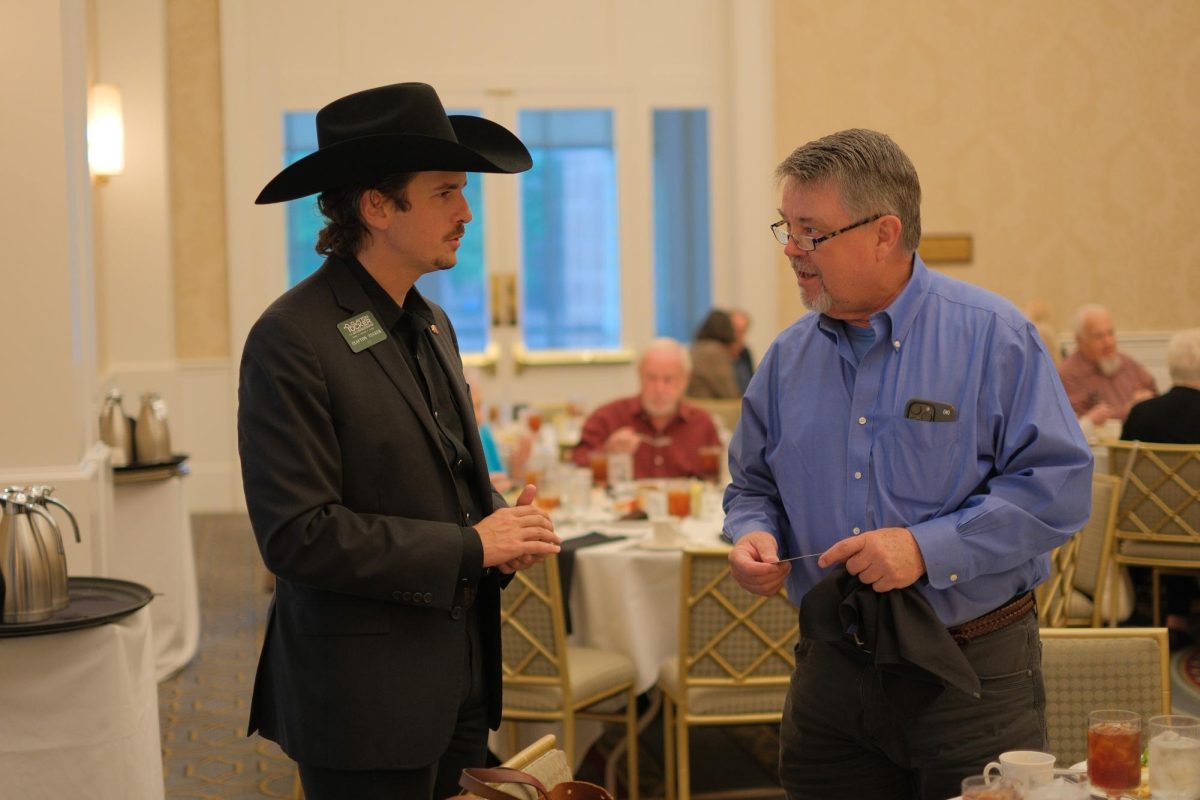
As the spring rain pattered against large glass windows, a tall black dressed cowboy watched over a herd of several dozen public officials, interest groups, lobbyists and concerned citizens as they grazed over the buffet line for the Dallas Democratic Forum luncheon. Attendees gathered to listen, on April 21, to this rancher from Lampasas speak about the pitfalls of artificial intelligence (AI) data centers.
“I run cattle, I run goats and I run my mouth,” Clayton Tucker, the democratic nominee for Texas Agriculture Commissioner, said. “I am the only Democrat [in Texas] openly talking about data centers and I get calls daily telling me to stop.”
During the forum, Tucker referred to Texas as the place where all the data centers are going as they get kicked out of other states. According to Visual Capitalist, only Virginia has more operating data centers than Texas, but overall has less planned and currently being built.
“My campaign is about food, water and land,” Tucker tells the crowd of lunch guests at the forum. He claims these are things the new and existing data centers will affect.
According to the Pew Research Center, data centers across the nation are moving into rural communities where they can buy land cheaper from the aging population of farmers at an increasing rate. But Tucker argues these data centers are going to affect every Texan, whether rural or urban. “Our electricity prices will rise $100-200 a month,” Tucker said.
In February, the Texas Standard reported on the cost of living rising significantly in Abilene due to the 4 million square foot Stargate data center project. The surge was due to the construction workers who came in to work. This pattern has repeated across the country and often here in Texas.
Cost of living may be the forefront for many nationally, but for data centers it is just the tip of the iceberg. Tucker questions why Big Tech is rushing to build them before lawmakers have time to study the impacts and put potential regulations in place. The health of residents, soil and livestock near data centers could be at risk.
“This is the dotcom bubble all over again,” Tucker said. “We know it’s a bubble and they know it’s a bubble. That is why they are fighting so hard to build so many.”
If Tucker is elected, he would be the first Democrat ag commissioner since Jim Hightower held the office from 1983 to 1991.
His opponent on the Republican side, Nate Sheets, is a Dallas-based honey importer. He took large donations from pro-AI data center individuals and business interests in his primary challenge against Sid Miller, the incumbent ag commissioner.
“I thought Miller had a hereditary position,” Ben Shaw, a Texas cattle rancher said after Sheets secured the nomination. Many saw this as a result of Miller’s split with Abbott on the topic of data centers in Texas.
Like Tucker, Miller was against building AI data centers on Texas farmland and using the decreasing water supply to cool them.
“When you think about data centers coming into West Texas, there’s going to be a lot of water that’s used there, but we’ve got water issues,” Sheets said in an article for Big Country, a West Texas news publisher out of Abilene. “So inside of Texas Department of Agriculture, we need to ensure that we are helping farmers and ranchers identify the latest technology that delivers the most amount of water for the least amount of effort.”
For the Texas Republican Party, the challenge is selling this issue to their strongest base: rural Texans. Tucker said, across the state, his campaign has encountered many Republicans who are angry with the way the state is letting tech companies buy their local politicians and ram through plans for data centers in their communities.
A Cameron County Republican party member, who did not wish to be named, told The Courier: “Sheets will have a real problem connecting with rural Texans. He is from Dallas and he is pro-something many Texans out here are vehemently against.”
“Time is not on their [Big Tech] side, but time is on our side,” Tucker said. “If we delay them, we stop them.”