A federal lawsuit has been launched against Texas Tech University by one of its own law students. Ellen “Ellie” Fisher, a third-year law student and founder of the university’s NAACP chapter, argues that the university is violating her constitutional rights after comments she made regarding the September 2025 assassination of conservative personality, Charlie Kirk. With this legal action, a spotlight is shining on where the intersection of freedom of speech, student conduct codes and political expression meets.
The Texas Tech School of Law Honor Council investigated Fisher after receiving reports that she made loud, happy and celebratory remarks in classrooms and clinic offices on the day of Kirk’s death. Fisher was found to be in violation of the school’s honor code, adding a written reprimand to her permanent record.
Fisher’s lawsuit states that she was unjustly isolated for punishment and documents that there were witnesses who reported other students who made comparable comments. They did not face any sort of disciplinary action.
According to the lawsuit, Fisher – who was the only Black student in one specific class where the topic of Kirk’s assassination was being discussed – was targeted for her point of view.
According to the case file, Fisher reported a racist slur was graffitied on her car, the university deemed it to be irrelevant in the case.
Michael Thad Allen, her attorney, was critical of the universities and their handling of the matter stating, “What kind of lawyers are they going to produce at the Texas Tech School of Law?” he said. “They can’t be made to feel uncomfortable? That is infantilizing.”
This case is rising to the top of minds amidst the national debate about the limits of what speech is permissible in public institutions.
Some argue that universities have a responsibility to always be professional and provide a safe environment, especially with regards to harassment or unprofessional conduct.
On the opposite side of the argument, “safe spaces” are producing a caliber of students who are not prepared for the real-world workforce where they will have to go up against those who do not put feelings as a high priority. They need to learn the quote from “The Godfather,” “It’s not personal, it’s strictly buiness.”
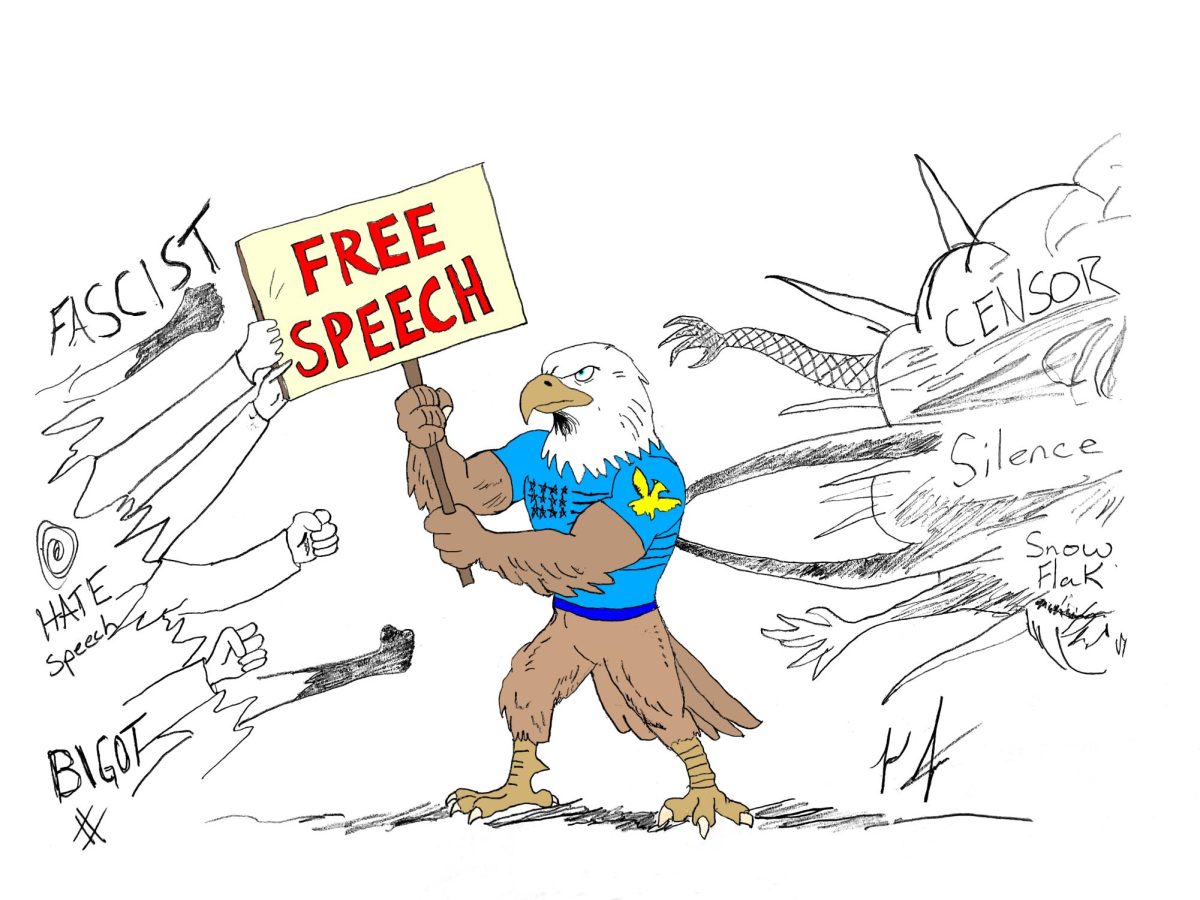
Texas Tech, as a public university, is subject to the restrictions set by the First Amendment and therefore cannot take action that limits a person’s freedom of speech.
Justice William J. Brennan, Jr. in the U.S. Supreme Court case Texas v. Johnson states, “If there is a bedrock principle underlying the First Amendment, it is that government may not prohibit the expression of an idea simply because it finds it offensive or disagreeable.”
Those who are critical of the culture produced on many university campuses will often pit the American system against the restrictive laws of other countries. Even in perceived free speech bastions such as the United Kingdom, Canada and Australia, what you say and/or write online can put you into jail if the government sees it as incitement.
In the U.K., Simon Ledger was arrested for singing the popular 1970s song “Kung Fu Fighting” at a bar in 2011, then released without charge. In Canada, journalist Yves Engler spent several days behind bars for criticizing a pro-Israeli commenter on X in Montreal, Quebec, in 2025. In Australia, a pregnant woman, Zoe-Lee Buhler, was arrested in her home for promoting an anti-lockdown protest on Facebook during COVID-19 pandemic.
Considering that Fisher is mocking a prominent conservative personality’s murder, one could believe she is aligned with the liberal side of the political spectrum. That side of the aisle is constantly promoting the restriction of free speech by labeling it as hate speech; when they forget that the political pendulum of power constantly swings from the left to the right, an executive order can switch which party is in jail and which is free during their administration.
As a nation we should fight against the loss of free speech no matter how heinous and detestable it may be to those who hear it, so long as it fits within the constitutional constraints of the First Amendment.